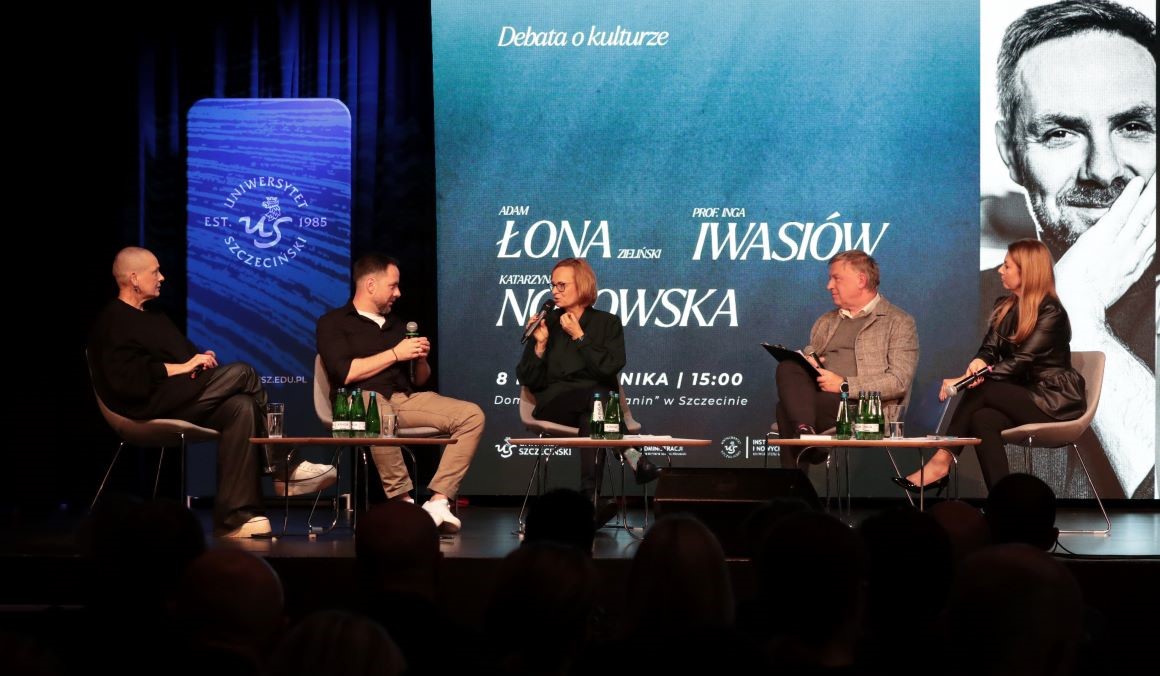
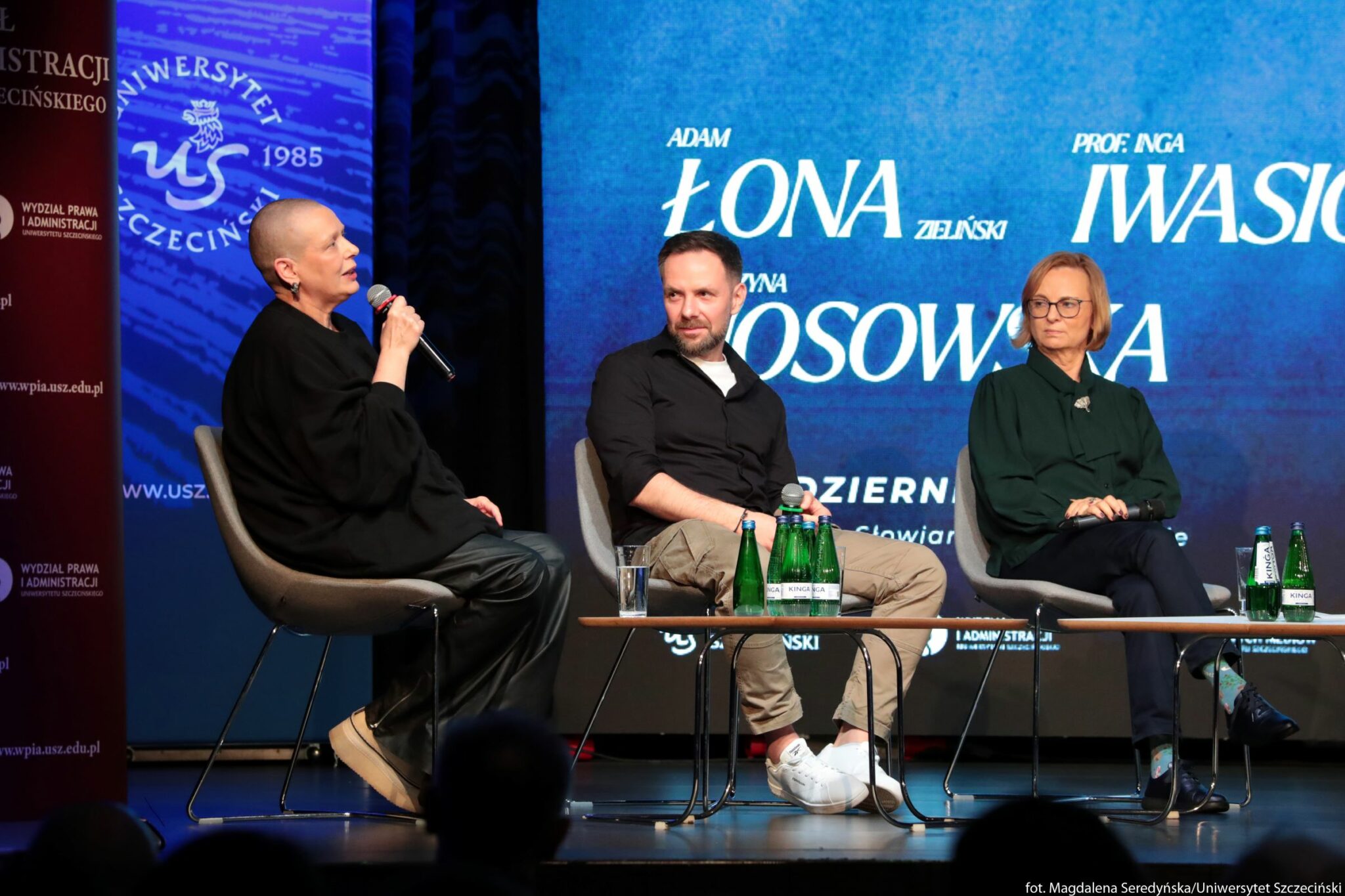
On October 8, 2026, the “Słowianin” Cultural Centre hosted a debate entitled “A Country Trapped in ‘What-Ifs’…”. The panel featured writer Prof. Inga Iwasiów alongside artists Katarzyna Nosowska and Adam “Łona” Zieliński. The discussion centered on culture, the role of art, and the notion that artists are an integral part of the community and the voice of society.
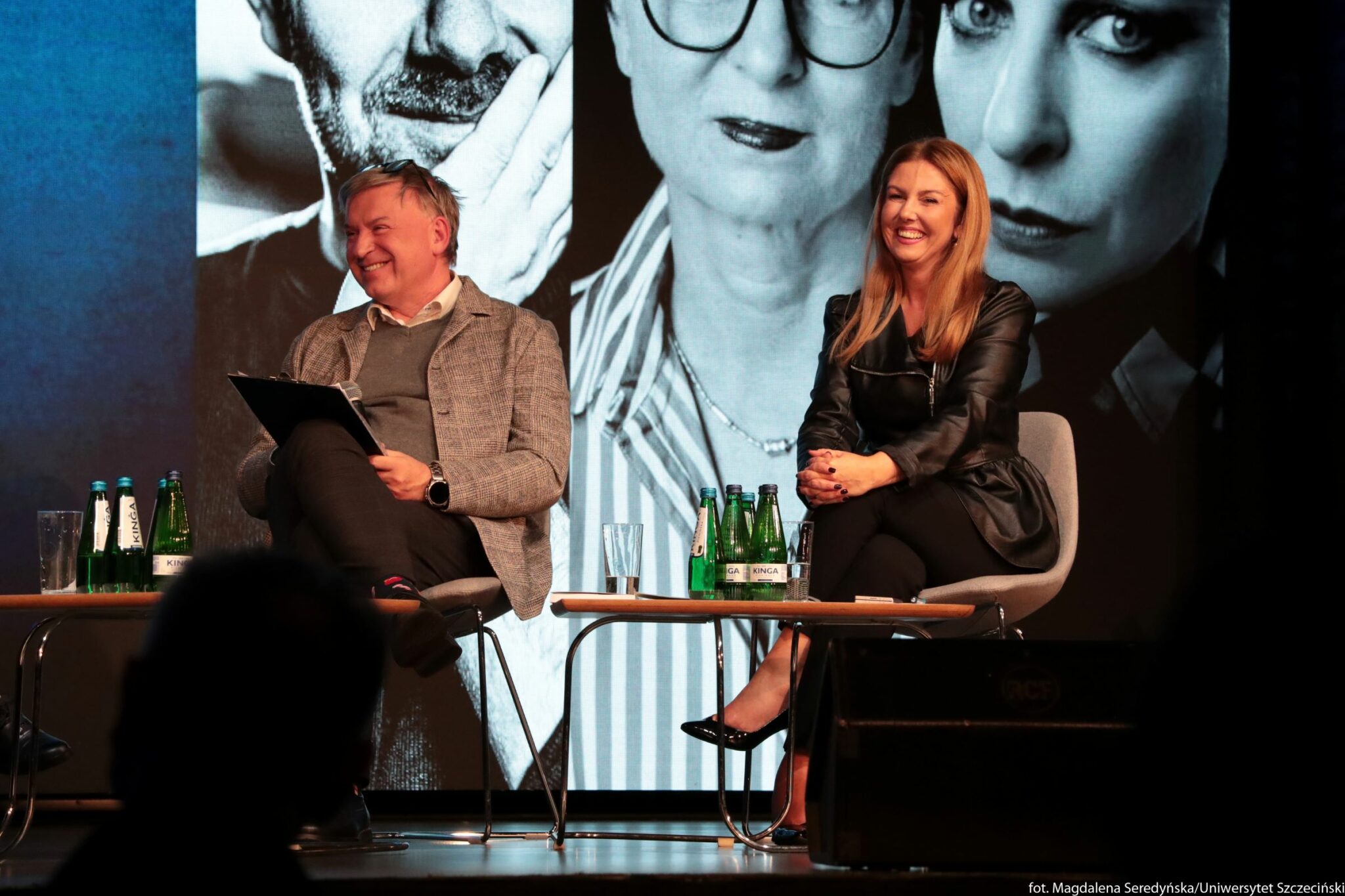
The debate was moderated by Prof. Dr. Hab. Andrzej Skrendo—Vice-Rector for Science at the University of Szczecin, literary scholar, and active contributor to Szczecin’s cultural and media landscape—together with Dr. Hab. Ewelina Cała-Wacinkiewicz, Associate Professor at US and Dean of the Faculty of Law and Administration at the University of Szczecin, from which Adam Zieliński graduated. It was the University of Szczecin Medal, recently awarded to Łona, that provided the impetus for organising this event.
The title of the debate, “A Country Trapped in ‘What-Ifs’…”, refers to Adam “Łona” Zieliński’s track “Gdzie tak pięknie?” (“Where Else So Beautiful?”), in which the word “if” (gdyby) recurs repeatedly— “if Szczecin were closer to Warsaw,” “if I hadn’t run away,” “if I were younger,” and ultimately “my whole country trapped in if.” This word conditions action and rationalizes its absence through successive unfavorable circumstances, leaving behind unused potential. The debate demonstrated that not only do circumstances and actions carry meaning, but words also possess agency—serving either as a driving force or as something that clips one’s wings.
As the moderators emphasized, anyone wishing to belong to a community bears certain civic duties, and the prominence of artists accords them the right to speak out on matters of utmost importance and to fight in defense of fundamental values.
Art and literature are tools for expressing things that are important to individuals, society and humanity, and for taking a stand on an issue. There are issues that can be traced back to a particular social group or community, and which can be seen as rooted in fundamental principles, such as social justice. In such cases, I can act as their advocate and do what I am capable of, which is to write about the subject – be it a column, a literary work or an academic paper. Engaged humanities seek to explore ideas in a way that is useful to people today. However, I do not believe in neutral humanities, because they always speak on someone’s behalf. It is impossible not to hold a view whilst practising them. What we wish to represent always shines through in our writing. I cannot imagine being a writer who does not know whom she is addressing or who does not know what she wishes to represent,’ pointed out Professor Inga Iwasiów, emphasising that, as a researcher, she had spent years studying literature by asking questions precisely about its contextual determinants. According to her, we are cogs in the system. Whilst it is true that there are fields of science which can be considered neutral, even these are entangled, for example, in the conditions under which science is practised or in funding, and that is no longer freedom.
Adam ‘Łona’ Zieliński also emphasised that one should create in harmony with oneself, and that culture takes shape through action.
Our primary field of operation is the creation of culture. In my view, the creator’s sole duty is to be at one with oneself. This opens the door to a wide variety of things, and these various things take place
within people. What I like most is this kind of dialogue with the audience, where effort is required on both sides – where the author, the sender of the signal, sends a somewhat coded message, and the audience’s role is not only to receive it, but to make a certain intellectual effort to decode it. ‘As long as the creator is sincere, their work is the result of something that is true,’ noted Adam ‘Łona’ Zieliński. He also emphasised that artists have the right to set boundaries and express their disagreement on issues that matter to them. For him, writing lyrics is also a form of emotional regulation. He noted that it is a great thing to be able to express oneself in this way and to have an audience with whom this content resonates and with whom they identify.
Art turns out to be a safe space not only for audiences, but also for the artists themselves.
I cannot imagine being where I am today, or being who I am, were it not for music and literature. Music has always transported me to spaces I perceive as safe. In my own writing, I generally focus on that which is close to the individual, rather than addressing macro-societal matters. However, there are indeed moments—though I do not do this often—when it is simply impossible to remain silent, when one must express that they see value in people uniting around a cause. I try not to do so frequently because I am not a specialist in these affairs. I am an idealist. I believe that music connects people, that there is a place where we can all meet once we strip away the labels associated with profession, affiliations, and political sympathies. My specialization lies in articulating that which resides deep within me, within us, in the belief that when stripped of all these decorations, our experiences are remarkably similar—that we are all living the exact same lives—said Katarzyna Nosowska.
The debate concluded that artists have a right to a voice and that they have a duty to speak out on issues shared by their audience. We live in a society where everyone follows their own path, yet on certain levels we can always come together and offer one another mutual support. Through their works, artists express themselves, whilst their audience finds themselves.
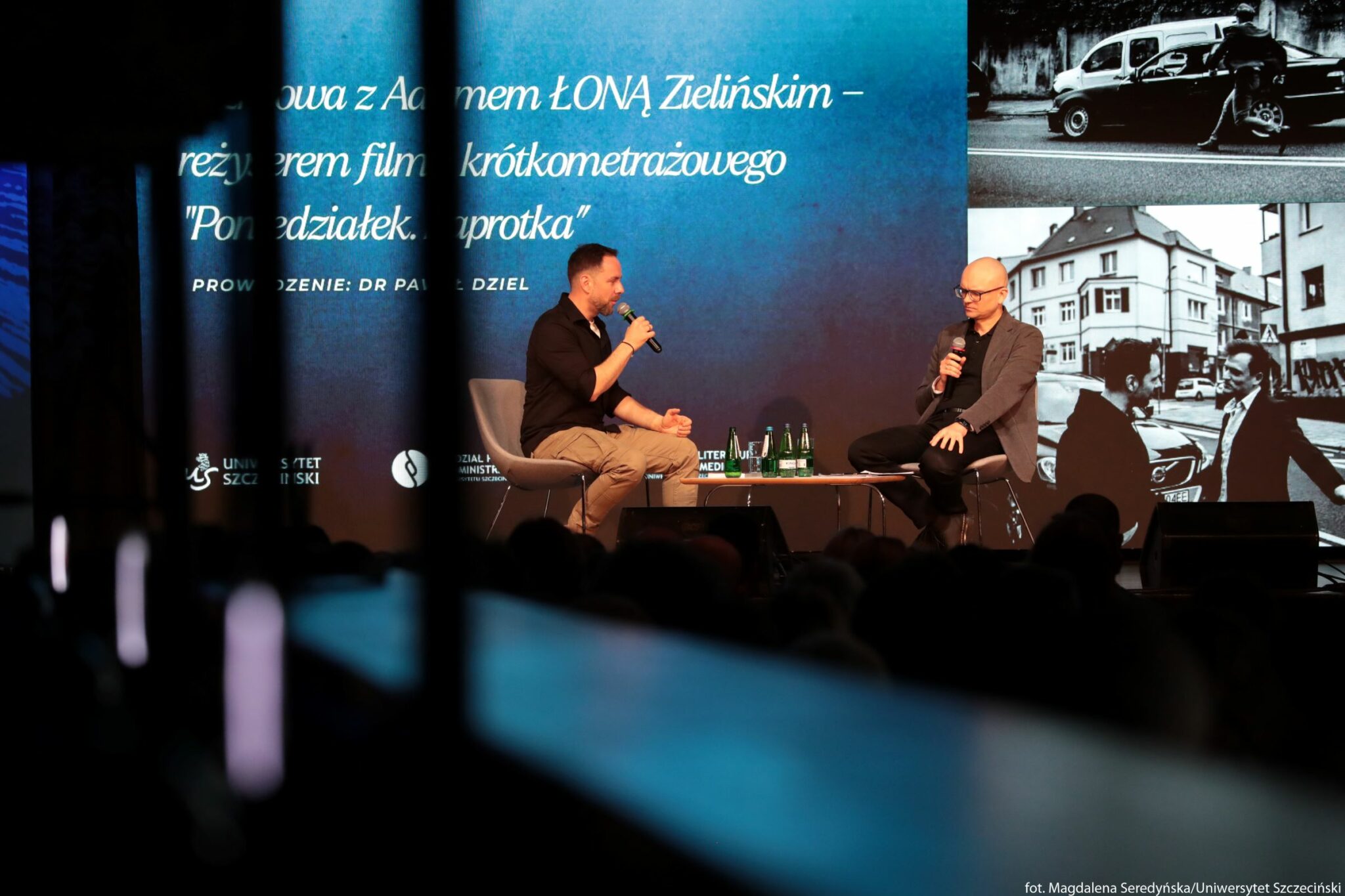
Following the debate, there was a discussion and a screening of the short film “Monday. Paprotka”, directed by Adam ‘Łona’ Zieliński, with Dawid Dziarkowski in the lead role. Dr Paweł Dziel led the discussion with the filmmaker. The film was received enthusiastically by the audience.
The audience also enthusiastically received the performance by Łona accompanied by musicians Andrzej Konieczny and Kacper Krupa—co-creators of the album TAXI, which was honored with Fryderyk Awards for portraying reality through the perspective of taxi drivers and their passengers.
It is worth mentioning that the day before, on 7 October 2026, a workshop was held at the University of Szczecin for US students, during which young writers spoke with Adam ‘Łona’ Zieliński about writing lyrics and crafting a message. The students learnt the art of mastering words and left the workshop with a handful of tips on how to put their thoughts down on paper in a unique way.
Report by UNIWIZJA – University of Szczecin Television