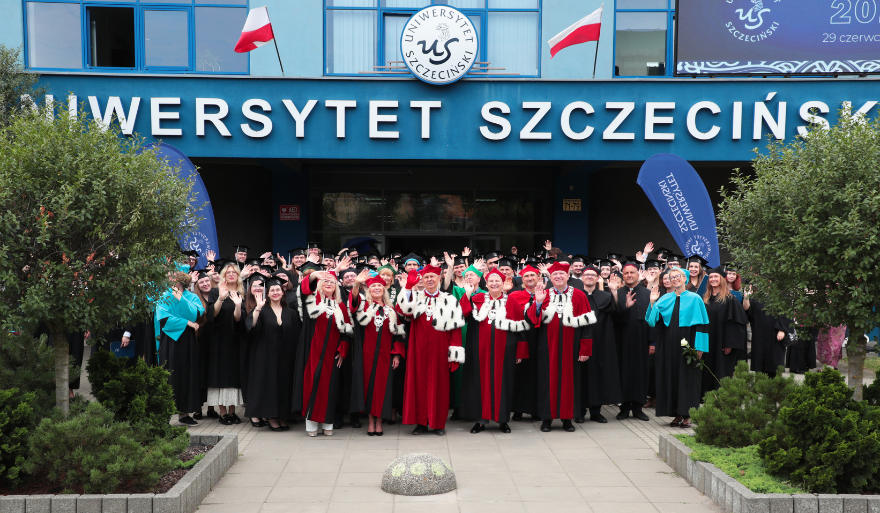
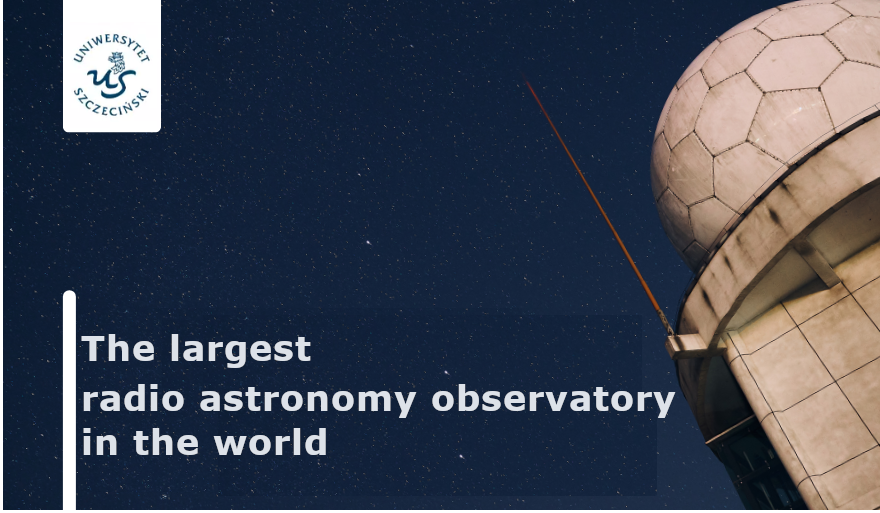
The Polish Consortium for the SKA Observatory (SKAO) project was established on 15 September 2025. The agreement was signed at the Nicolaus Copernicus University Astronomical Observatory in Piwnice, near Toruń. This international initiative aims to build the world’s largest radio astronomy observatory. The University of Szczecin is among the eight scientific institutions that forms the consortium.
The project partners are the University of Warsaw, the Jagiellonian University in Kraków, the Nicolaus Copernicus Astronomical Centre of the Polish Academy of Sciences, the National Centre for Nuclear Research, the University of Warmia and Mazury in Olsztyn, the University of Zielona Góra, and Nicolaus Copernicus University in Toruń as the project coordinator.
The SKA Observatory (Square Kilometre Array Observatory – SKAO) is an initiative to build a radio astronomy observatory, with a target area of one square kilometer. The SKAO infrastructure will be distributed across three continents. A broadband antenna system with a low frequency of 50 to 350 MHz (designated SKA Low) is being built in the Murchison region of Western Australia. A parabolic antenna system is being built in the Karoo in South Africa, which will collect radio signals at a medium frequency of 350 MHz to 14 GHz (designated SKA Mid). Both locations were chosen for their low radio interference, crucial for precise observations. SKAO’s headquarters is located at Jodrell Bank Observatory in the UK. The location of SKAO’s antennas in the southern hemisphere is also dictated by astronomical considerations. This location allows for a better view of our home galaxy, particularly its center, which is particularly interesting due to the supermassive black hole it houses.
The SKAO project aims to answer fundamental questions in cosmology and astrophysics related to the origins of the universe, the origins of dark matter and dark energy, the sources of gravitational waves, the search for life in the universe, the study of cosmic magnetism, and the monitoring of so-called space weather. Numerous other research projects are also planned, with conceptual work underway within working groups in which Polish scientists are already participating.
SKAO is a unique undertaking on a global scale. Currently, there are no radio astronomy research infrastructures comparable to what SKAO is expected to become in a few years. Moreover, SKAO will be unique not only in terms of astronomical infrastructure but among all research facilities in general. The scale, complexity, and cost of this undertaking can be compared to the construction of the Large Hadron Collider (LHC), the largest elementary particle accelerator ever built by humanity. The LHC has answered a number of key questions related to the structure of the microworld, confirming, among other things, the existence of the Higgs boson. SKAO, on the other hand, is being built to address questions related to the structure and evolution of the macroworld, and with its enormous research potential, it will be the only infrastructure of its kind for decades to come. The next such observatory will likely be built beyond Earth – on the far side of the Moon – or in outer space, to avoid ever-increasing radio interference.