

On 3 June 2025, the Yeast TardigradeGene experiment payload reached the Kennedy Space Center (KSC) in Florida, the launch site of the Axiom Mission 4 (Ax-4) mission. The next stage of preparing the modified yeast culture for the flight to the International Space Station (ISS) as part of the Polish IGNIS mission was successfully completed.
The yeast was inoculated in a previously prepared medium on 25 May at around 6:00 p.m. in the laboratory of the Bioenergetics Department of the Institute of Molecular Biology and Biotechnology, Faculty of Biology, Adam Mickiewicz University in Poznań. Then, all elements of the experiment were integrated. In the final phase of integration, the yeast culture was placed in a specially prepared container covered with an orange Nomex layer by the University of Szczecin, in which the yeast will make its space journey.
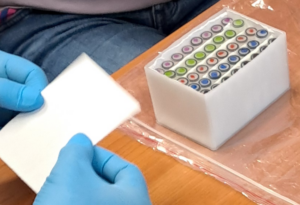
Bottles of five different yeast strains tightly packed in a 3D-printed polypropylene box
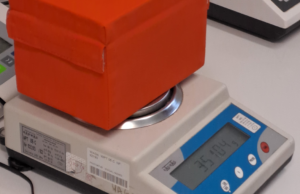
The orange container ready to fly while its weight is checked.
The question may easily arise: why is the color of the container orange? It turns out that aesthetic considerations were not taken into account here. The color of the container sent to the ISS carries the information that the orange container is to return to Earth after the mission is completed.
The moment before the payload was placed on the scale was very emotional. The team knew perfectly well that the weight of the payload could not exceed the value given in the flight documentation. Everyone breathed a sigh of relief when the scale indicated a value lower than the permissible one. The task was completed with flying colors. The payload prepared in this way was properly secured and placed in a refrigerator and remained there until morning. The next morning, May 26, in a special thermal container cooled with dry ice, it set off for Florida.
During transport, the temperature remained in the range of 3.8 – 5.8 degrees Celsius, and its average value was 5.2 ± 0.3 degrees Celsius. This means that the payload of the Yeast TardigradeGene experiment was transported in optimal temperature conditions. Now that the payload is in place, we are all waiting for the launch of the Ax-4 mission and its Polish part IGNIS, the first scientific and technological mission to the ISS.
The Yeast TardigradeGene experiment is being implemented by a consortium of three universities coordinated by the University of Szczecin, consisting of the University of Szczecin, Adam Mickiewicz University in Poznań and the University of Silesia in Katowice.