
“The Cooperation beyond the horizon. IGNIS – Polish technological and scientific mission to the ISS” meeting took place on 5 February 2025. It was a great opportunity for the University of Szczecin team to meet personally the with the crew of the Ax-4 mission at the Copernicus Science Center in Warsaw.
The mission commander Peggy Whitson (USA) and both mission specialists Sławosz Uznański-Wiśniewski (Poland) and Tibor Kapu (Hungary) met with journalists, entrepreneurs and with the young people, the future of the space sector. The members of the Yeast TardigradeGene team could not be missing here. Their presence emphasized the fact that the academic community is very interested in cooperation with the space sector and has a lot to offer both in the cognitive sphere and in the application of research conducted on Earth and in space.
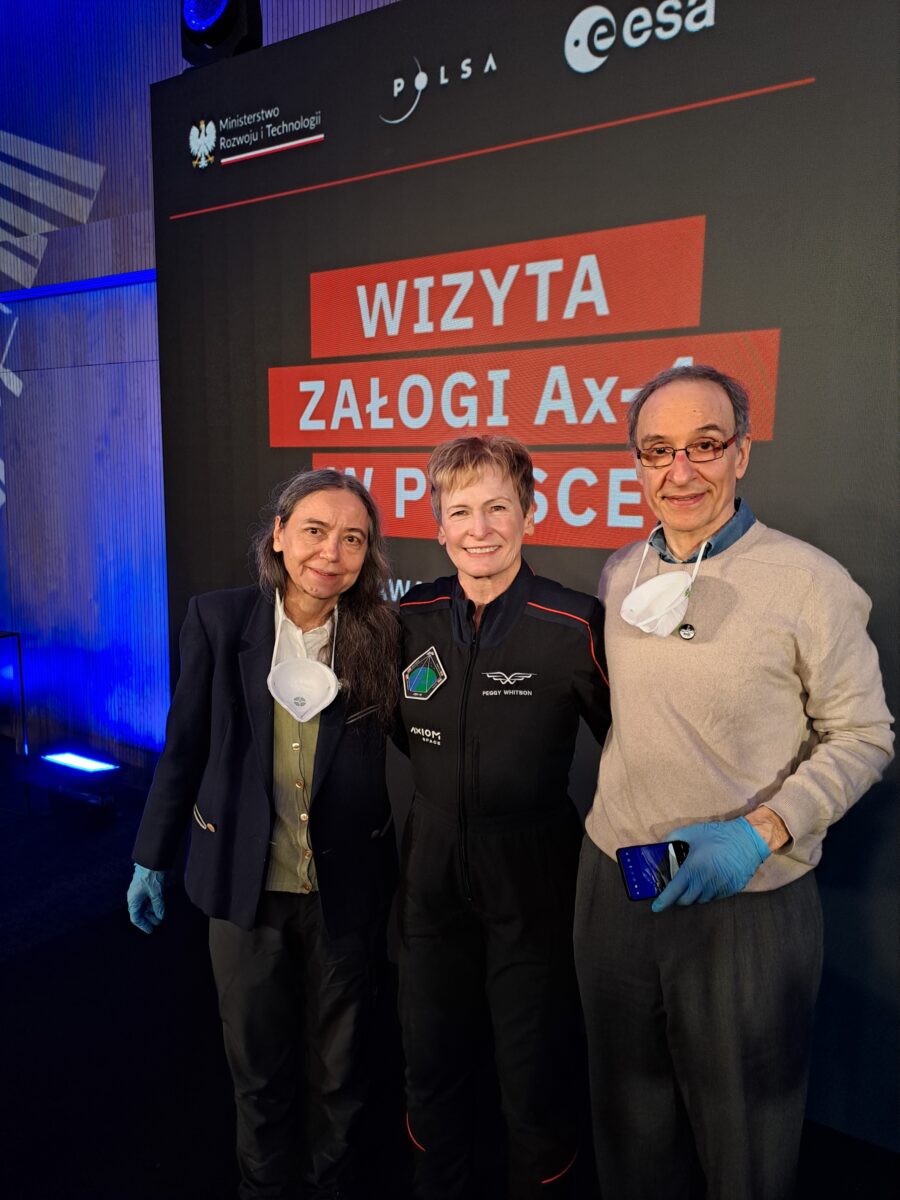
prof. Ewa Szuszkiewicz and prof. Franco Ferrari – the Yeast TardigradeGene team from the Institute of Physics of the University of Szczecin with Peggy Whitson the Ax-4 mission commander.
The Yeast TardigradeGene is practically ready to fly. The payload, which will carry the modified yeast culture to the low Earth orbit was designed and manufactured so that its mass and volume were as small as possible. This required miniaturization of containers with biological samples, selection of lightweight and durable materials. Materials used to construct the flight version of the payload must also meet very precisely defined safety standards. The elements proposed for the flight were subjected to numerous tests, which guarantee the correct course of the experiment at every stage, starting from transporting samples to the rocket launch site, through the journey to the ISS, culturing yeast in microgravity conditions, returning to Earth and transporting back to the laboratory.
The tests were carried out jointly by team members from the University of Szczecin and Adam Mickiewicz University in Poznań and were successful. Technical support from the Center for Bioimmobilization and Innovative Packaging Materials of the West Pomeranian University of Technology in Szczecin was also particularly helpful. Safety standards have been met and the cargo has been handed over to the European Space Agency (ESA). Two milestones have now been achieved. The most anticipated one will take place in the spring, the flight of modified yeast to the ISS.
The Yeast TardigradeGene project (full name – Before we fly to Mars: Can tardigrades help protect other organisms in space?) is carried out as part of the first Polish technological and scientific mission to the International Space Station (ISS) – Ignis, which is part of Axiom Mission 4 (Ax-4). Ignis is financed by the Ministry of Development and Technology and carried out in cooperation with the European Space Agency and the Polish Space Agency (POLSA).
Work on the Yeast TardigradeGene project is being carried out by a consortium of three universities, which includes: the University of Szczecin (as the coordinator), Adam Mickiewicz University in Poznań and the University of Silesia in Katowice.